
INSECTFRASS Project
INSECTFRASS is a research project focused on advancing sustainable agricultural practices through the development of innovative, environmentally friendly pest control solutions. The project addresses the growing need to reduce reliance on synthetic pesticides by exploring nature-based and circular-economy approaches.
Specifically, INSECTFRASS aims at the development of environmentally friendly, sustainable, and natural pest control tools that employ biowaste products—namely frass, including its associated microbial communities and bioactive compounds—to combat key agricultural pests. By valorising biowaste streams, the project seeks to contribute to integrated pest management strategies, environmental protection, and the long-term sustainability of agricultural production systems.
Through interdisciplinary research and collaboration, INSECTFRASS generates scientific knowledge and practical outcomes with the potential to support farmers, researchers, and policy makers in the transition towards more sustainable and resilient agri-food systems.
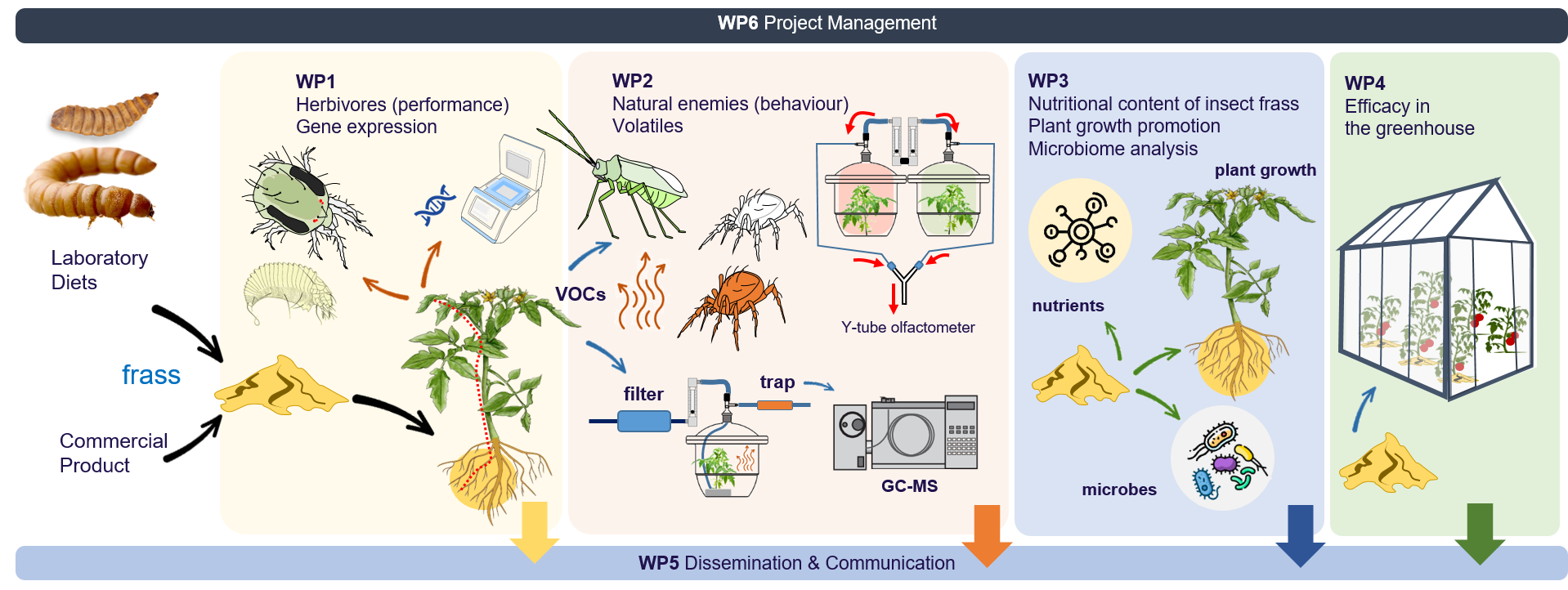
INSECTFRASS follows a multidisciplinary approach to reach the following objectives:
Identify
Identify and characterize different IFs produced by different insect species fed with different diets and their microbiome or microbial communities that induce direct and indirect plant resistance/tolerance to aboveground arthropod pests, the latter via enhanced attraction of natural enemies.
Understand
Understand the molecular and chemical mechanisms underlying the plant-mediated effects of frass/microbial communities on host plant defence to biotic stressors.
Evaluate
Evaluate the potential of IF as soil amendment with plant protection capabilities.